

HomeInformation CenterIndustry News
NEWS CENTER

Information Center

Focusing on fire safety industry trends, policies, regulations, and technological frontiers, we consistently provide you with authoritative and professional information.

10Fire Safety Knowledge
8Information
PinnedIndustry NewsLatest
中加沃安SINOWOAN High-Rise Escape Safety Rope & Descender Product Educational Guide
Author:Zhejiang Sinowoan Technology Co., Ltd.Published 225 阅读About 5 minutes
High-Rise EscapeSafety RopeControlled Descent DeviceFire Safety EducationReciprocating Controlled Descent DeviceOperation & Usage

SINOWOAN High-Rise Escape Safety Rope & Descender Device Product Guide
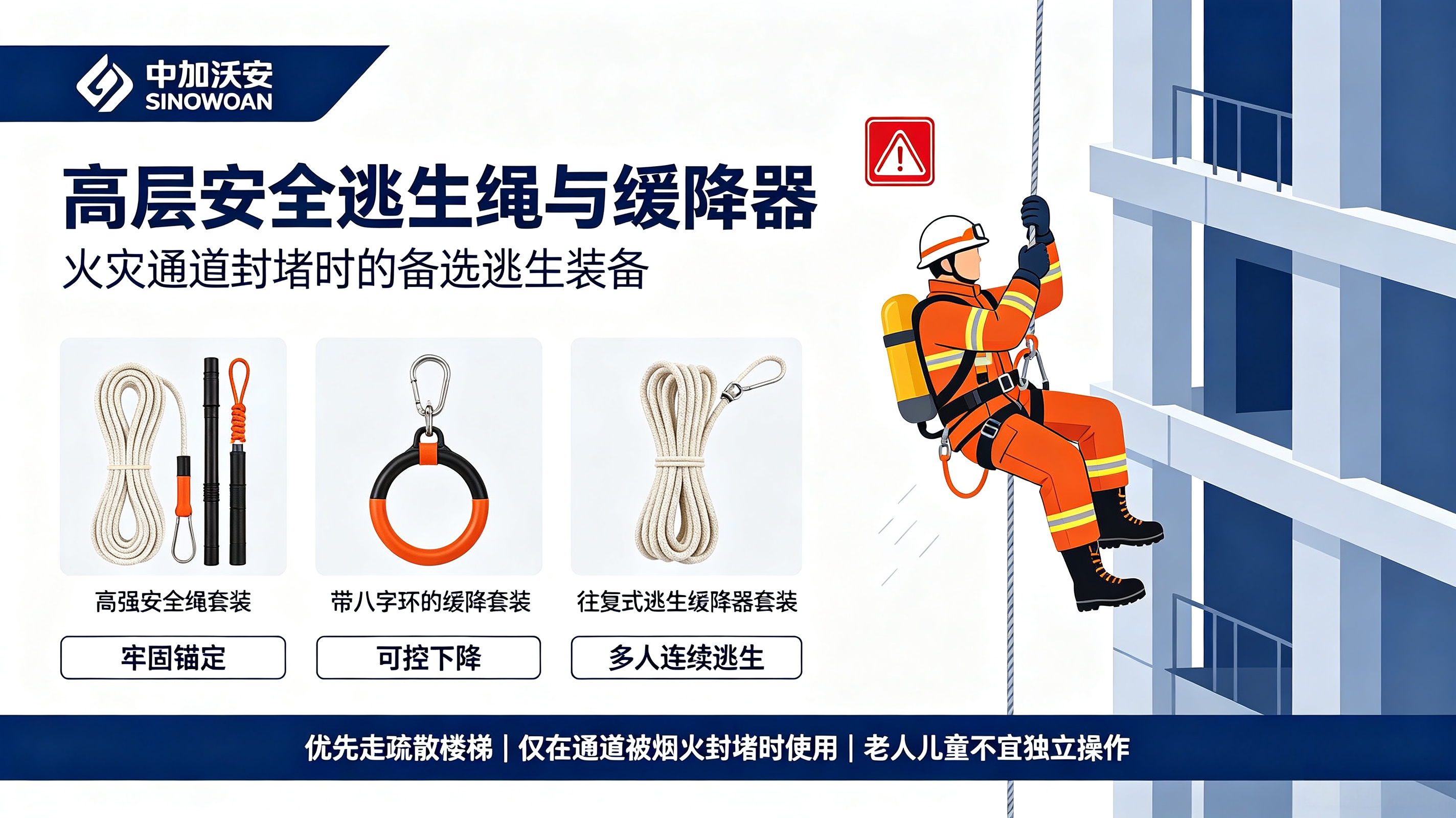
I. Differences & Comparative Introduction of 3 Rope-Based Escape Products

SINOWOAN rope-based escape equipment is categorized into three types: Steel-Core Simple Escape Rope, Standard Fiber Escape Rope, and Reciprocating Escape Descender Device Kit, suitable for different floors, residential, and commercial scenarios.

Product Name

Core Material

Rope Specifications

Core Configuration

Product Features

Limitations

Applicable Scenarios

Steel-Core Simple Escape Rope

Outer flame-retardant braided fiber, internal aviation steel wire core, 10mm diameter

Multiple lengths available from 10–100m, suitable for 2–30 story buildings

Dual large snap hooks + simple safety harness + anti-slip gloves

Internal steel core prevents easy breakage under fire; high tensile strength; moderate price; compact storage volume, easy for household storage; allows manual rappelling escape

No automatic speed control mechanism, requires mastery of rappelling techniques; difficult for the elderly and children to operate alone

Residential homes, rental properties, as auxiliary escape equipment, standby for 2–15 story buildings

Standard Fiber Escape Rope

Flame-retardant polyester synthetic fiber, 10mm diameter

10–50m options

Safety snap hook, simple safety harness, protective gloves

Soft rope body, lightweight, good flexibility; lower cost; tight braiding, meets national standard escape rope strength; smooth handling

No steel wire core, carries risk of melting under prolonged open flames; not suitable for prolonged exposure to high-temperature fire and dense smoke environments

Low-rise residential buildings, temporary protection for outdoor operations; not recommended as primary choice for high-rise fires

Reciprocating Escape Descender Device Kit

Aviation steel wire rope inner core + flame-retardant outer braid, equipped with speed-regulating main unit

Multiple specifications from 10–100m, corresponding to 2–30 stories

Speed-regulating main unit, safety harness set, safety anchor hook, fixing base, aluminum storage case

CCCF certified, relies on deadweight for steady automatic descent; enables reciprocating continuous escape for multiple people; stable descent speed of 0.16–1.5m/s, no manual control required; metal host provides reliable protection; preferred equipment for high-rise fires; complete set of accessories

Relatively heavy total kit weight; higher cost; unauthorized disassembly and lubrication of the main unit are strictly prohibited; must be paired with reliable wall anchor fixtures

High-rise residential buildings, office buildings, B&Bs, commercial hotels; preferred choice for floor 7 and above

Purchasing Summary: For high-rise buildings above the 7th floor, prioritize the reciprocating escape descender kit; for households below the 7th floor with a limited budget, choose a steel-wire core simple escape rope; ordinary fiber ropes are only suitable for low floors and should not be used as the primary fire escape solution. In a fire emergency, evacuation stairs should be prioritized, and escape ropes should only serve as an alternative when stairs are blocked.

II. Correct Operation Method (Referencing the Four-Step Guide: Hook, Throw, Wear, Descend)

Title: Fire Safety Science · Four-Step Operation for Escape Descender Equipment

1. Step 1: Hook: Securely lock the main safety carabiner onto the pre-installed wall anchor point or a solid load-bearing structural component of the building. The safety lock catch must be fully engaged in place, and ensure that the anchor point can support human weight.

2. Step 2: Throw: Throw the rope reel completely out of the window, ensuring the rope is free of knots and tangles throughout its entire length, and confirm that there is no one on the ground below.

3. Step 3: Wear: Put on the half-body safety harness correctly by fitting it under the armpits and tightening the buckle; do not wear it over one shoulder only; put on non-slip protective gloves.

4. Step 4: Descend: Stand on the inside of the windowsill, lean your body out of the window, gently push against the wall with your feet, and descend at a steady speed relying on your own body weight; quickly unfasten the safety harness to evacuate after landing; for the reciprocating model, pull down the rope after landing for the next person to escape.

Bottom dark blue prompt bar: Use only when stairwells are blocked by smoke and fire; independent operation by the elderly, children, and people with mobility impairments is not recommended; prioritize evacuation via escape stairs.

III. Key Points for Use and Storage

Precautions for Use

1. Before use, be sure to confirm that the fixed anchor point is firm and reliable; it must not be hung on non-load-bearing components such as air conditioner outdoor units, window frames, or clothes drying racks.

2. Face the wall during descent and lightly kick against the wall with your hands and feet to prevent your body from colliding with building walls and sharp edges, and to prevent the rope from being cut.

3. For reciprocating controlled descent devices, unauthorized disassembly of the speed control host is strictly prohibited, and injecting lubricating oil into it is strictly prohibited, as this will cause the speed control mechanism to fail and lead to a fall risk.

4. Avoid direct friction between the rope and sharp edges; at the fire scene, prevent open flames from burning the rope directly.

5. If it has already sustained the impact of a falling person or has been used in an actual fire escape, the entire set of equipment must be scrapped directly and reuse is strictly prohibited.

Storage Key Points

1. Store in a dry, well-ventilated indoor location away from light, close to the window/balcony access point; keep away from high-temperature heat sources, oil fumes, acids and alkalis, oil stains, and corrosive chemicals.

2. The rope should be coiled and stored naturally; do not fold tightly or compress for long periods. Keep the aluminum case set closed for protection.

3. Avoid placing it on a balcony with long-term exposure to sun and rain; prevent metal hooks and the main unit from moisture and rust.

4. Families need to familiarize themselves with the equipment accessories in advance. It is recommended to conduct regular simulated assembly and disassembly drills; do not wait until a fire occurs to open it for the first time.

IV. Routine Inspection and Scrapping Standards

Routine Inspection (Visual inspection recommended once a quarter, complete verification annually)

1. Rope Body Inspection: The outer braided layer of the rope must be free of wear, fuzzing, cuts, scorching, melting, or discoloration from chemical corrosion; for models with a steel wire core, if the outer layer is damaged, focus on checking whether there are broken wires inside.

2. Metal Hardware: The safety snap hook opens and closes smoothly, and the safety spring rebounds normally; hooks, D-rings, and anchor bases are free of cracks, deformation, and severe rust; the descender main body housing is intact without impact damage or deformation.

3. Safety Harness Webbing: The harness is free from cuts, abrasion, hardening due to aging, and mildew; stitching is free from unraveling.

4. Identification and Labels: The product nameplate, model number, executive standard, manufacturing date, and obsolescence period markings are complete and legible.

5. Additional Inspection for Reciprocating Descenders: Test by gently pulling the rope to confirm that the mechanism operates without jamming or abnormal noise. If any abnormality is found, stop using it immediately and contact the manufacturer for inspection and repair; do not disassemble it by yourself.

If any of the following occurs, the entire set must be scrapped and replaced

1. The rope shows cuts, extensive fraying/fluffing, burns or scorching, chemical corrosion, or broken wires in the steel wire core.

2. The harness webbing is aged, mildewed, or has torn stitching; metal snap hooks or anchor points show cracks or plastic deformation.

3. Has been subjected to an actual escape fall impact; the entire set must be scrapped regardless of its external appearance.

4. The reciprocating descent control device has suffered collisions, water ingress, unauthorized disassembly, or lubrication addition, or the mechanism is jammed or emits abnormal noises.

5. The product has reached the maximum storage lifespan specified by the manufacturer (the storage period for descent devices generally does not exceed 10 years, subject to the product nameplate).

6. The label/nameplate has fallen off, making it impossible to verify the model and date of manufacture.

Popular Science Note: Escape ropes and descent devices do not have a uniform mandatory national scrapping lifespan. They are judged based on both the manufacturer's instructions on the product nameplate and the actual inspection condition. If any scrapping condition is met, replace with a new product immediately.

V. Summary of Model Selection Guidelines

Low-rise residential buildings (Floors 1-6): Simple wire-core escape ropes can be selected, with operation practiced in advance; High-rise residential buildings and commercial premises (Floor 7 and above): Priority should be given to CCCF-certified reciprocating escape descent device sets; Ordinary fiber ropes are suitable for low-rise non-fire emergency protection and are not recommended for high-rise fire escape; Important reminder: The first choice for fire escape is always the evacuation stairwell; rope devices serve only as a backup plan when escape routes are blocked by smoke and fire.

Related Information

New energy vehicle fires: Escape window may only be a few minutes — On-vehicle fire safety equipment configuration guide
Fire Safety Knowledge2026-10-21
The world's first mass-produced, with extended fire resistance rating...
Company News2026-10-07
Good News | Zhejiang Zhongjiawoan Technology adds another intellectual property achievement
Information2026-09-29
HomeProductInformationContact
HomeInformation CenterIndustry News
NEWS CENTER

Information Center

Focusing on fire safety industry trends, policies, regulations, and technological frontiers, we consistently provide you with authoritative and professional information.

10Fire Safety Knowledge
8Information
PinnedIndustry NewsLatest

中加沃安SINOWOAN High-Rise Escape Safety Rope & Descender Product Educational Guide

Author:Zhejiang Sinowoan Technology Co., Ltd.Published
225 阅读
Estimated reading time 5 minutes
Tags:High-Rise EscapeSafety RopeControlled Descent DeviceFire Safety EducationReciprocating Controlled Descent DeviceOperation & Usage

SINOWOAN High-Rise Escape Safety Rope & Descender Device Product Guide

I. Differences & Comparative Introduction of 3 Rope-Based Escape Products

SINOWOAN rope-based escape equipment is categorized into three types: Steel-Core Simple Escape Rope, Standard Fiber Escape Rope, and Reciprocating Escape Descender Device Kit, suitable for different floors, residential, and commercial scenarios.

Product Name

Core Material

Rope Specifications

Core Configuration

Product Features

Limitations

Applicable Scenarios

Steel-Core Simple Escape Rope

Outer flame-retardant braided fiber, internal aviation steel wire core, 10mm diameter

Multiple lengths available from 10–100m, suitable for 2–30 story buildings

Dual large snap hooks + simple safety harness + anti-slip gloves

Internal steel core prevents easy breakage under fire; high tensile strength; moderate price; compact storage volume, easy for household storage; allows manual rappelling escape

No automatic speed control mechanism, requires mastery of rappelling techniques; difficult for the elderly and children to operate alone

Residential homes, rental properties, as auxiliary escape equipment, standby for 2–15 story buildings

Standard Fiber Escape Rope

Flame-retardant polyester synthetic fiber, 10mm diameter

10–50m options

Safety snap hook, simple safety harness, protective gloves

Soft rope body, lightweight, good flexibility; lower cost; tight braiding, meets national standard escape rope strength; smooth handling

No steel wire core, carries risk of melting under prolonged open flames; not suitable for prolonged exposure to high-temperature fire and dense smoke environments

Low-rise residential buildings, temporary protection for outdoor operations; not recommended as primary choice for high-rise fires

Reciprocating Escape Descender Device Kit

Aviation steel wire rope inner core + flame-retardant outer braid, equipped with speed-regulating main unit

Multiple specifications from 10–100m, corresponding to 2–30 stories

Speed-regulating main unit, safety harness set, safety anchor hook, fixing base, aluminum storage case

CCCF certified, relies on deadweight for steady automatic descent; enables reciprocating continuous escape for multiple people; stable descent speed of 0.16–1.5m/s, no manual control required; metal host provides reliable protection; preferred equipment for high-rise fires; complete set of accessories

Relatively heavy total kit weight; higher cost; unauthorized disassembly and lubrication of the main unit are strictly prohibited; must be paired with reliable wall anchor fixtures

High-rise residential buildings, office buildings, B&Bs, commercial hotels; preferred choice for floor 7 and above

Purchasing Summary: For high-rise buildings above the 7th floor, prioritize the reciprocating escape descender kit; for households below the 7th floor with a limited budget, choose a steel-wire core simple escape rope; ordinary fiber ropes are only suitable for low floors and should not be used as the primary fire escape solution. In a fire emergency, evacuation stairs should be prioritized, and escape ropes should only serve as an alternative when stairs are blocked.

II. Correct Operation Method (Referencing the Four-Step Guide: Hook, Throw, Wear, Descend)

Title: Fire Safety Science · Four-Step Operation for Escape Descender Equipment

1. Step 1: Hook: Securely lock the main safety carabiner onto the pre-installed wall anchor point or a solid load-bearing structural component of the building. The safety lock catch must be fully engaged in place, and ensure that the anchor point can support human weight.

2. Step 2: Throw: Throw the rope reel completely out of the window, ensuring the rope is free of knots and tangles throughout its entire length, and confirm that there is no one on the ground below.

3. Step 3: Wear: Put on the half-body safety harness correctly by fitting it under the armpits and tightening the buckle; do not wear it over one shoulder only; put on non-slip protective gloves.

4. Step 4: Descend: Stand on the inside of the windowsill, lean your body out of the window, gently push against the wall with your feet, and descend at a steady speed relying on your own body weight; quickly unfasten the safety harness to evacuate after landing; for the reciprocating model, pull down the rope after landing for the next person to escape.

Bottom dark blue prompt bar: Use only when stairwells are blocked by smoke and fire; independent operation by the elderly, children, and people with mobility impairments is not recommended; prioritize evacuation via escape stairs.

III. Key Points for Use and Storage

Precautions for Use

1. Before use, be sure to confirm that the fixed anchor point is firm and reliable; it must not be hung on non-load-bearing components such as air conditioner outdoor units, window frames, or clothes drying racks.

2. Face the wall during descent and lightly kick against the wall with your hands and feet to prevent your body from colliding with building walls and sharp edges, and to prevent the rope from being cut.

3. For reciprocating controlled descent devices, unauthorized disassembly of the speed control host is strictly prohibited, and injecting lubricating oil into it is strictly prohibited, as this will cause the speed control mechanism to fail and lead to a fall risk.

4. Avoid direct friction between the rope and sharp edges; at the fire scene, prevent open flames from burning the rope directly.

5. If it has already sustained the impact of a falling person or has been used in an actual fire escape, the entire set of equipment must be scrapped directly and reuse is strictly prohibited.

Storage Key Points

1. Store in a dry, well-ventilated indoor location away from light, close to the window/balcony access point; keep away from high-temperature heat sources, oil fumes, acids and alkalis, oil stains, and corrosive chemicals.

2. The rope should be coiled and stored naturally; do not fold tightly or compress for long periods. Keep the aluminum case set closed for protection.

3. Avoid placing it on a balcony with long-term exposure to sun and rain; prevent metal hooks and the main unit from moisture and rust.

4. Families need to familiarize themselves with the equipment accessories in advance. It is recommended to conduct regular simulated assembly and disassembly drills; do not wait until a fire occurs to open it for the first time.

IV. Routine Inspection and Scrapping Standards

Routine Inspection (Visual inspection recommended once a quarter, complete verification annually)

1. Rope Body Inspection: The outer braided layer of the rope must be free of wear, fuzzing, cuts, scorching, melting, or discoloration from chemical corrosion; for models with a steel wire core, if the outer layer is damaged, focus on checking whether there are broken wires inside.

2. Metal Hardware: The safety snap hook opens and closes smoothly, and the safety spring rebounds normally; hooks, D-rings, and anchor bases are free of cracks, deformation, and severe rust; the descender main body housing is intact without impact damage or deformation.

3. Safety Harness Webbing: The harness is free from cuts, abrasion, hardening due to aging, and mildew; stitching is free from unraveling.

4. Identification and Labels: The product nameplate, model number, executive standard, manufacturing date, and obsolescence period markings are complete and legible.

5. Additional Inspection for Reciprocating Descenders: Test by gently pulling the rope to confirm that the mechanism operates without jamming or abnormal noise. If any abnormality is found, stop using it immediately and contact the manufacturer for inspection and repair; do not disassemble it by yourself.

If any of the following occurs, the entire set must be scrapped and replaced

1. The rope shows cuts, extensive fraying/fluffing, burns or scorching, chemical corrosion, or broken wires in the steel wire core.

2. The harness webbing is aged, mildewed, or has torn stitching; metal snap hooks or anchor points show cracks or plastic deformation.

3. Has been subjected to an actual escape fall impact; the entire set must be scrapped regardless of its external appearance.

4. The reciprocating descent control device has suffered collisions, water ingress, unauthorized disassembly, or lubrication addition, or the mechanism is jammed or emits abnormal noises.

5. The product has reached the maximum storage lifespan specified by the manufacturer (the storage period for descent devices generally does not exceed 10 years, subject to the product nameplate).

6. The label/nameplate has fallen off, making it impossible to verify the model and date of manufacture.

Popular Science Note: Escape ropes and descent devices do not have a uniform mandatory national scrapping lifespan. They are judged based on both the manufacturer's instructions on the product nameplate and the actual inspection condition. If any scrapping condition is met, replace with a new product immediately.

V. Summary of Model Selection Guidelines

Low-rise residential buildings (Floors 1-6): Simple wire-core escape ropes can be selected, with operation practiced in advance; High-rise residential buildings and commercial premises (Floor 7 and above): Priority should be given to CCCF-certified reciprocating escape descent device sets; Ordinary fiber ropes are suitable for low-rise non-fire emergency protection and are not recommended for high-rise fire escape; Important reminder: The first choice for fire escape is always the evacuation stairwell; rope devices serve only as a backup plan when escape routes are blocked by smoke and fire.

Related InformationRecommended for you