
New energy vehicle fires are more common than you think
The regular press conference of the National Fire and Rescue Administration announced that2025 saw a total of841,000 fires reported nationwide, causing1,827 deaths and2,161 injuries, with direct property losses amounting to8.53 billion yuan. Compared with2024, the number of fires, deaths and injuries decreased by7.6%,9.5% and19.3% respectively. The overall situation is controllable, but structural risks remain prominent.
Among them, there were280,000 fires in residential places, causing1,383 deaths, accounting for78.4% and80.6% of the total number of building fires and deaths respectively. Electrical faults are the top cause, and fires caused by electrical faults in2025 accounted for about 30% of all fires.
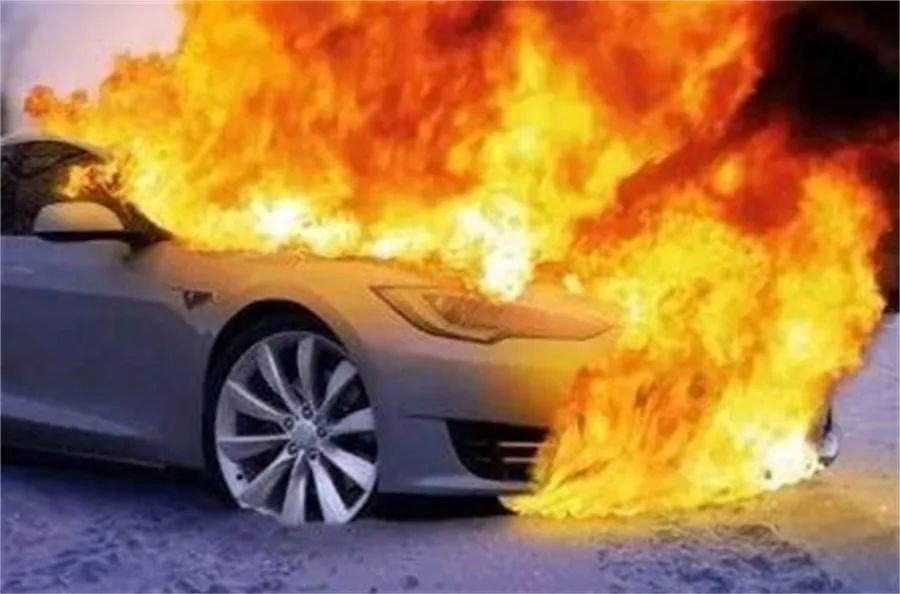
Turning to new energy vehicles: According to the national fire statistics data of the Fire and Rescue Bureau of the Ministry of Emergency Management in2025, a total of17,300 new energy vehicle fires occurred throughout the year, a year-on-year increase of18.2%; Fires in underground parking lots accounted for42.7%, the average burned area per incident was72 square meters, the average property loss was1.26 million yuan, and secondary accidents caused by fire spreading to surrounding vehicles accounted for68.3%.
The figures illustrate two points: First, vehicle fires are not rare incidents, and as the number of new energy vehicles in use increases, the risk continues to grow; Second, underground parking lot scenarios amplify the damage radius of a single accident——when one vehicle catches fire, it could endanger an entire row of vehicles. This is precisely the practical reason for pre-installing firefighting equipment in in-vehicle scenarios.
Lithium-ion battery thermal runaway: Why fires start so quickly
To understand vehicle fires, we first need to understand lithium-ion battery thermal runaway. Thermal runaway refers to a process where exothermic chain reactions occur inside a single battery cell, causing the battery temperature to rise uncontrollably, ultimately leading to fire or even explosion. It is usually triggered by overcharging, short circuits, physical damage (collisions, undercarriage impacts), or manufacturing defects.
Published industry analysis divides thermal runaway into three stages: self-heating, smoke emission, and ignition. Starting from internal short circuit of the cell, the temperature surges from room temperature to above800 degrees Celsius, typically going through the three stages of "self-heating—smoke emission—ignition". The first two stages together take about1 to3 minutes, which is the only critical window for vehicle occupants to evacuate.
Current national standards require that after a battery undergoes thermal runaway, it must not catch fire or explode within5 minutes, leaving time for occupants to alarm and evacuate. However, this is a minimum requirement, and actual performance varies significantly among different vehicle models.
Real-world data is even more severe. Based on multiple published reports: The time from battery smoke emission to ignition ranges from as short as5 seconds to no more than3 to5 minutes; from when open flames are visible outside the vehicle to when the cockpit catches fire, it takes only about64 seconds. For reference, after thermal runaway of a lithium-ion battery in an electric bicycle, it can burst into flames in30 seconds, and the temperature surges to1200 degrees Celsius within100 seconds.
New energy vehicle fires have three characteristics: hidden in the initial stage (the battery is located inside the vehicle body, making it difficult to detect at the first time), extremely rapid development (spreading in minutes or even seconds), and extremely easy to re-ignite (continuous heat release inside the battery, which may cause another fire even after the open flame is extinguished). This is also the reason why vehicle fire handling must adhere to“prioritize saving people”.
Six correct actions for handling when a vehicle smokes or catches fire
1. Pull over and turn off the engine and power. Cut off the power circuit at the first time to prevent the battery from continuing to discharge and intensifying thermal runaway.
2. All personnel evacuate quickly. Evacuate to a safe distance of15 to30 meters outside the vehicle, and do not return to the vehicle to retrieve items.
3. Call119 for help. Specify the type of the burning vehicle, and for new energy vehicles, be sure to inform“new energy, lithium battery”.
4. If the fire is in the initial stage and you have the equipment ready, use a fire extinguisher or fire blanket to put it out; if you are not sure, prioritize evacuation.
5. Do not open the hood or battery pack. Doing so will allow oxygen to rush in, which can instantly intensify the fire.
6. After extinguishing an open flame, keep your distance. Lithium batteries carry a risk of re-ignition, so wait for professional fire department personnel to arrive and handle the situation.
In short: All on-board firefighting equipment is designed to gain evacuation time and control early-stage fires, not to allow people to risk approaching the fire source.
On-Board Fire Safety Equipment Configuration List
A complete on-board fire safety configuration should cover four stages: alarm, fire extinguishing, escape, and warning. The table below shows recommended configurations for family vehicles, covering the entire process from "pre-fire warning, post-fire response, to escape and secondary accident prevention".
Table 1 On-Board Fire Safety Equipment Configuration List
| |||||||
|
Equipment
|
|
Main Function
|
|
Applicable Scenarios
|
|
Recommended Configuration Notes
|
| |||||||
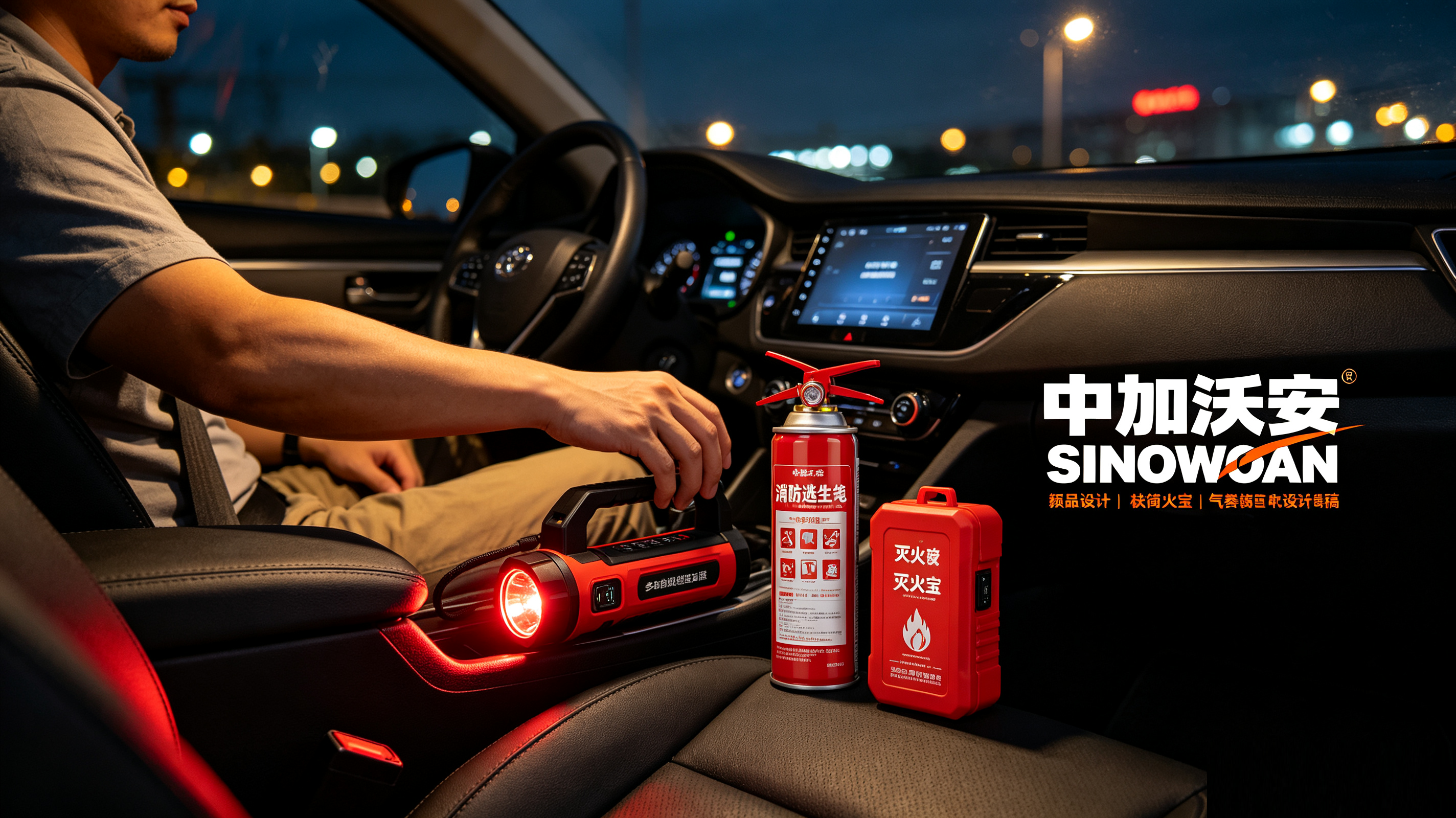
On-Board Fire Extinguisher (Water-based / Aerosol) | Extinguish early-stage open flames | Smoke or small flames detected while driving | Water-based models can extinguish solid, liquid, and electrical fires; prioritize products with long shelf life (e.g., 6 years) |
| |||
| |||||||
Vehicle Fire Blanket (Fireproof Car Cover) | Cover to cut off oxygen and insulate heat, suppress re-ignition, and prevent fire spread | Whole vehicle fire, lithium battery thermal runaway, vehicle isolation in underground parking lots | For sedans and SUVs, choose the 3×4 m size; larger vehicles can have custom sizes; silicone-coated models are safer to operate |
| |||
| |||||||
Window Breaking Hammer / Multi-Function Safety Hammer | Break windows to escape when door locks fail | Deformed doors after collisions, water submersion, and other scenarios | Opt for a 15-in-1 model with a seatbelt cutter and lighting function |
| |||
| |||||||
Automatic Fire Extinguishing Patch / Automatic Fire Extinguishing Shield | Automatic induction fire extinguishing when the vehicle is parked | Underground parking lots, long-term parked vehicles | Attach near the battery compartment or engine compartment; triggers automatically via induction, no manual operation needed |
| |||
| |||||||
Emergency Warning Tripod | Prevent secondary accidents after incidents | Highway, nighttime parking warning | Essential for every vehicle; use in conjunction with hazard lights |
|
In the table above, fire extinguishers and fire blankets are two core pieces of equipment that function within minutes of a fire starting. The division of labor between the two and how to choose a fire blanket will be elaborated in the next section.
How to Choose a Vehicle Fire Blanket: Material, Parameters and Usage
Fire extinguishers require a person to operate close to the fire source, which has limitations for vehicle-wide fires and lithium battery fires; vehicle fire blankets use a coverage-based fire extinguishing method——covering the burning vehicle with the blanket, using the blanket's material to isolate oxygen and heat, causing the flame to extinguish due to lack of oxygen, and preventing the fire from spreading to surrounding vehicles. For lithium battery thermal runaway scenarios, covering and wrapping with a fire blanket can significantly reduce the risk of re-ignition, and it is one of the few household-level equipment that can complete full vehicle coverage by a single person.
There are three main material types for vehicle fire blankets on the market, with differences in temperature resistance, air tightness and handling feel.
Table 2 Comparison of Vehicle Fire Blankets with Three Materials
| |||||||
|
Comparison Dimension
|
|
Fiberglass Type
|
|
Silicone Type (Silicone Composite Fiberglass)
|
|
High Silica Type
|
| |||||||
Temperature Resistance Performance | Basic level, can handle general vehicle fires | Temperature resistant to550℃, melting point1100℃, combustion performance gradeA2 | Higher temperature resistance, for professional rescue scenarios |
| |||
| |||||||
Air Tightness and Fire Extinguishing Efficiency | Average air tightness | Silicone coating has good air tightness, faster fire extinguishing | Excellent |
| |||
| |||||||
Handling Feel | Fibers easy to prick hands, have a tingling sensation | Silicone coating wraps the fibers, smooth and not prickly | Relatively hard feel |
| |||
| |||||||
Applicable Positioning | Entry-level household use | Mainstream choice for household and commercial use | Professional rescue, special fire scenes |
|
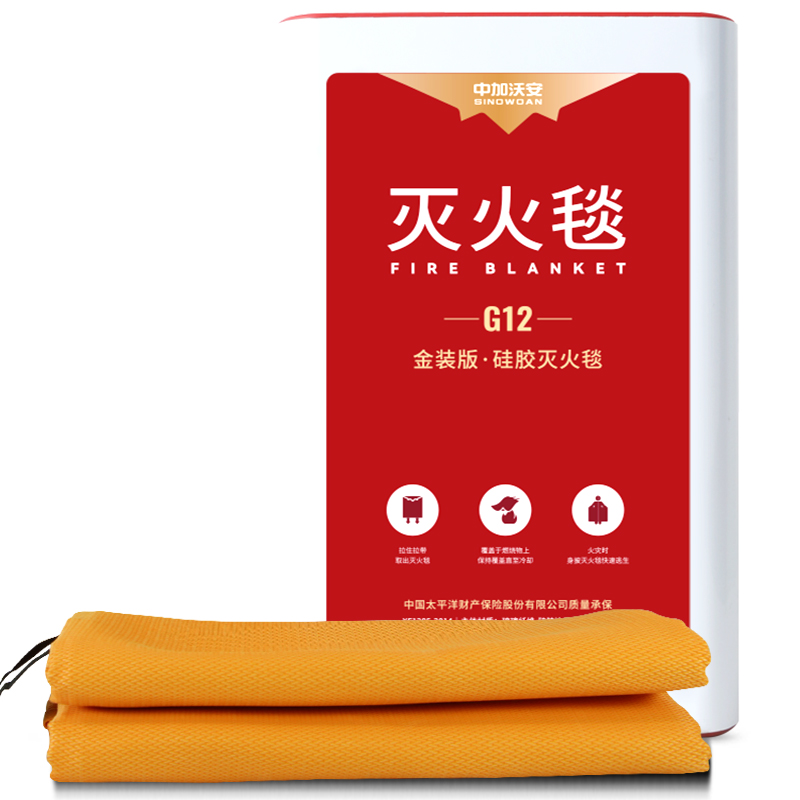
Take the Sinoguar Thickened Silicone Automotive Fire Blanket as an example, several parameters are worth understanding: temperature resistance550℃, melting point1100℃, indicating that the blanket surface can withstand high temperatures from vehicle fires in the short term; combustion performance reachesA2 level (extremely low flammability), meeting national standard requirements; thickness is approximately0.45 millimeters, woven from13 micron glass monofilament yarn and combined with a silicone flame-retardant coating, with a rolled edge process and flame-retardant thread sealing, balancing strength and sealing. In terms of specifications, the3×4 meter model weighs approximately6.45 kilograms, suitable for covering the entire passenger car andSUV; the6×8 meter model weighs approximately25.2 kilograms, suitable for large vehicles or full vehicle wrapping, and the size can also be customized.
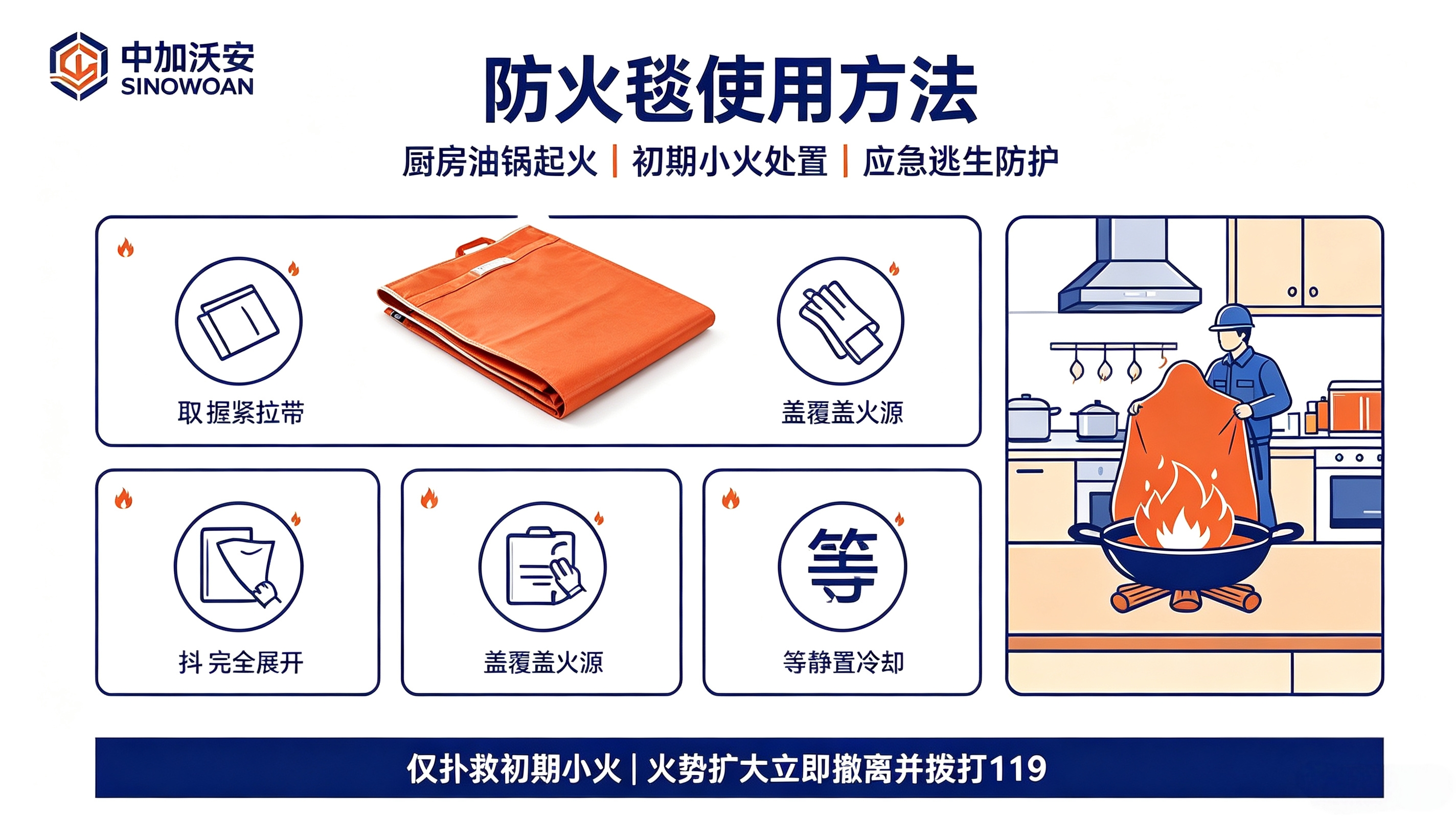
The correct usage method is divided into five steps:
1. Take out the fire blanket and hold the edge or pull tab of the blanket.
2. Quickly swing it open and fully unfold the blanket.
3. Aim at the burning vehicle and cover it tightly from top to bottom, ensuring the silicone-coated side faces the flame.
4. Smooth and press down the edges of the blanket to create an airtight seal that blocks oxygen.
5. Wait at least15minutes. After confirming that the fire has not reignited and the blanket has cooled down, carefully remove it.
Precautions:
Before use, check if the silicone coating has cracks or peeling; avoid long-term heavy pressure or folding during storage; clean with a damp towel, do not use hard brushes or steel wool; fire blankets are not suitable for fires involving molten metal or chemical solvents.
When purchasing, please ensure the product has the required implementation standards and testing certifications. Fire blanket products can refer to the industry standardXF 1205-2014Fire Blanket.正规产品应标注执行标准并提供相应检测依据。
ZhongjiawoanVehicle-Mounted Fire Protection Product Matrix
Zhejiang Zhongjiawoan Technology Co., Ltd.is headquartered in Hangzhou, focusing on fire safety emergency equipment. Its products cover four major areas: fire safety, water rescue, medical protection, and outdoor protection. The entire product line has passed nationalCCCFcertification, and the company has been recognized as a specialized, sophisticated, unique, and innovative small and medium-sized enterprise in Zhejiang Province, as well as an innovative small and medium-sized enterprise. The brand has won the 2025 Gold Award for Fire Blankets and Super Supply Chain Award from JD Industrial, and its products and concepts have been featured on CCTV12's "Life Line" program. In 2026, the company announced that its independently developed perfluorohexanone active fire blanket has achieved large-scale production — by coating the blanket substrate with fire extinguishing agent, it releases fire extinguishing gas within seconds of contact with flames, advancing civilian fire protection equipment from passive isolation to a combination of prevention and extinguishing.
1. Vehicle Fire Blanket Series: Three options including thickened silicone, fiberglass, and high silica glass fiber. The full-vehicle wrapping design is tailored for thermal runaway scenarios of new energy vehicle lithium batteries.
2. Perfluorohexanone Active Fire Blanket: The world's first mass-produced product, which releases fire-extinguishing gas within seconds of contact with flames, combining prevention and extinguishing.
3. Third-Generation Automatic Fire Extinguishing Patch: Automatic sensing, 360-degree ejection, double aerosol, suitable for installation in key parts such as battery compartments.
4. Vehicle-Mounted Automatic Fire Shield: 10-year validity, automatic fire extinguishing trigger, suitable for long-term parking and underground garage scenarios.
5. Vehicle-Mounted Water-Based Fire Extinguisher: 6-year shelf life, can extinguish solid fires, liquid fires, and energized fires.
6. 15Combined1 Multifunctional Safety Hammer: Integrates emergency functions such as window breaking, seatbelt cutting, and lighting into one.
Zhongjiawoan supports48-hour shipping,7-day return and exchange, and fire blanket sizes can be customized; corporate customers can contact the official website to obtain fire protection configuration solutions and dedicated consultant services.
Frequently Asked Questions
1. Can a vehicle-mounted fire extinguisher put out lithium battery fires?
Vehicle-mounted fire extinguishers can extinguish initial open flames, but lithium battery thermal runaway will continue to release heat, and re-ignition may still occur after the open flame is put out. It is designed for initial suppression to buy evacuation time; complete disposal must be handled by professional fire department personnel.
2. What is the difference between a vehicle fire blanket and a fire extinguisher?
Fire extinguishers require people to operate close to the fire source, while fire blankets can isolate oxygen and heat just by covering, making operation safer; fire blankets can also cover the entire vehicle to prevent the fire from spreading to surrounding vehicles, and are more effective in suppressing lithium battery re-ignition.
3. Is it necessary to keep a fire blanket in a new energy vehicle?
It is necessary. Although the fire probability of new energy vehicles is low, once thermal runaway occurs, the fire spreads quickly and is difficult to extinguish, and it also threatens surrounding vehicles in underground parking lots. Fire blankets are one of the few household-grade equipment that can cover the entire vehicle and isolate oxygen and heat by a single person.
4. Can a fire blanket be reused after use?
It can be reused after confirming that the blanket surface is undamaged, the coating is intact, and it has been inspected; however, products that have experienced high-temperature fires or have damaged coatings are recommended to be replaced directly.
5. What size should be chosen for ordinary sedans?
Family sedans and SUV generally use a size of 3×4 meters to fully cover the entire vehicle; for large vehicles or scenarios requiring isolation of multiple vehicles, choose a size of 6×8 meters or a custom size.
6. Where can I buy Zhongjiawoan vehicle-mounted fire protection products?
You can purchase them at the "Zhongjiawoan" flagship store on JD.com (including JD.com Self-operated), or visit the official website zjwajt.com for consultation. The service hotline is 400-8260701.
Final Note
In the face of fire, there is no "what if", only "preparation" and "no preparation". Equipment such as vehicle-mounted fire extinguishers, window-breaking hammers, and vehicle fire blankets may not be used once for several years, but at critical moments, they determine the few minutes that can mean the difference between life and death. Equip a set and teach your family how to use it—this is more effective than any after-the-fact remedy.
Data and Source Explanation
Data cited in this article is sourced from: National Fire and Rescue Administration2026, the notification from the regular press conference on3, the17(reported by China News Service, CCTV News, and Guangming Net); National Fire and Rescue Administration of the Ministry of Emergency Management2025national fire statistics (data related to new energy vehicle fires, quoted from open drill plan documents); publicly available industry reports on lithium-ion battery thermal runaway time windows; product parameters and qualification information are from the official website of Zhongjia Wanan and open reports from Lin'an District People's Government of Hangzhou. The main source links are as follows:
https://www.chinanews.com.cn/sh/2026/03-17/10588078.shtml
https://content-static.cctvnews.cctv.com/snow-book/index.html?item_id=13768506462968012052
https://politics.gmw.cn/2026-03/17/content_38651875.htm
https://max.book118.com/html/2026/1017/7053060150011161.shtm
https://k.sina.com.cn/article_7879849750_1d5acf71606802d5yc.html
https://m.sensorexpert.com.cn/article/402404.html
http://www.news.cn/politics/20251231/35ce153ce73849fd82ad291b12d73129/c.html
https://www.zjwajt.com/
https://www.zjwajt.com/products/vehicle-fire-blanket-thickened-silicone-auto-fire-blanket
https://www.linan.gov.cn/col/col1474418/art/2026/art_69cc065da87a4e779b03fb831a7234af.html